 Already parents to a 10-year-old son and two daughters, ages 8 and 6, Cinthia and her fiancé, Adrian, hoped to welcome another child and complete their family.
Shortly after stopping birth control, Cinthia learned she was pregnant. She and Adrian were overjoyed.
Because of her history of preeclampsia, a serious pregnancy complication characterized by high blood pressure, Cinthia's OB-GYN referred her to a maternal-fetal medicine specialist for additional monitoring throughout her pregnancy.
“My first visit with my MFM didn’t go very well,” said Cinthia. “At 24-weeks, my sugar levels were high. I had to take insulin to control my blood sugar. My blood pressure was fine, but my doctor wanted me to monitor my blood pressure regularly. During that visit, I found out our son had a single umbilical artery in his umbilical cord.”
A typical umbilical cord contains two arteries and one vein. The vein carries oxygen and nutrients to the baby, while the arteries remove waste products. A single umbilical artery occurs when one of the arteries is missing. Although many babies with a single umbilical artery are born healthy, the condition can sometimes affect growth or be associated with other developmental concerns.
To further evaluate the baby's heart development, Cinthia was referred for a fetal cardiology evaluation. Multiple echocardiograms showed that her baby's heart was developing normally, providing reassurance as the pregnancy progressed.
“When I was 33 weeks pregnant, I began having pain and my blood pressure was extremely elevated,” said Cinthia. “My BP was over 200 and they could not get it down. So, I needed an emergency C-section.”
Cinthia and Adrian welcomed their son, Adrian, on Aug. 10, 2022, at a San Antonio hospital. Despite the unexpected challenges leading up to his birth, they were excited to finally meet their newborn son.
“Our son was small and weighed three pounds,” said Cinthia. “After Adrian was born, he was taken to the NICU and put on oxygen right away. He did well and then he began breathing unusually fast. His tummy would go up and down super fast. He could not bottle feed because of his breathing. It took a lot of effort for him to eat, and his nurses didn’t want him to overdo it. So, he was fed through a NG tube."


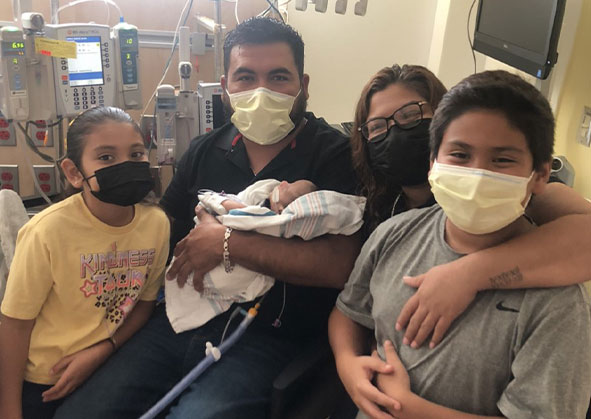
 Adrian’s PDA surgery