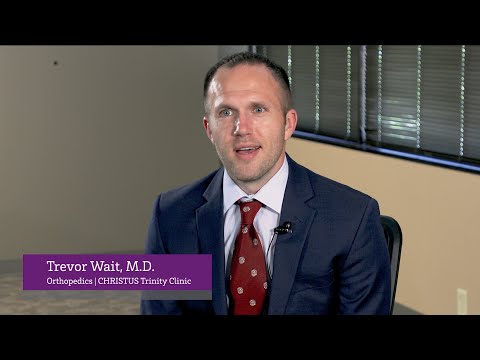
Meet Trevor Wait, MD
Double Board-Certified Surgeon for Athletes and Active Adults | Longview, TX
When an injury keeps you from competing, working or simply moving without pain, getting the right diagnosis and treatment matters.
Dr. Trevor Wait is an orthopedic surgeon with two board certifications: Orthopedic Surgery and Orthopedic Sports Medicine. He also completed a sports medicine fellowship and treats athletes and active adults at CHRISTUS Orthopedics & Sports Medicine Institute in Longview, Texas. He treats athletes and active adults with injuries of the knee, hip, shoulder, elbow and other joints, from common sports injuries to complex conditions that may require surgical reconstruction.
For Dr. Wait, caring for athletes is personal. Growing up in White Oak, his father was an athletic coach and a longtime public-school teacher. He was an all-state linebacker and later competed as an NCAA basketball player at Abilene Christian University.
After medical school and orthopedic surgery residency at the University of Texas Health Science Center at San Antonio, Dr. Wait completed a sports medicine fellowship at the UCHealth Steadman Hawkins Clinic of Denver. There, he served as an assistant team physician for the Denver Broncos, Colorado Rockies and Colorado Rapids.
He ultimately chose to bring that experience back to East Texas.
Career at a Glance
- Former assistant team physician for the Denver Broncos, Colorado Rockies and Colorado Rapids
- Published orthopedic researcher whose work includes ACL reconstruction, knee biomechanics, hip preservation, concussion recovery and surgical techniques
- Former NCAA athlete with firsthand experience of training, competition and recovery
- East Texas native who returned home to expand access to advanced orthopedic and sports medicine care
Specialized Orthopedic and Sports Medicine Care
Dr. Wait treats a wide range of injuries and joint conditions, with particular expertise in helping athletes and active patients return to the activities that matter to them.
His areas of care include:
- ACL tears and complex knee injuries
- Meniscus and cartilage injuries
- Hip labral tears and hip impingement
- Shoulder instability, rotator cuff and labral injuries
- Sports-related fractures and acute injuries
- Complex elbow fractures in young athletes
- Tendinitis, bursitis and overuse injuries
- Arthritis of the knee, hip and shoulder
- Joint replacement when damage becomes severe
Advanced Knee and ACL Surgery
ACL injuries are not all the same. Younger athletes, people who have torn a reconstructed ACL before and patients with unusually flexible joints can face a greater risk of another injury.
For some of these patients, Dr. Wait uses an additional stabilization procedure called Lateral Extra-articular Tenodesis, or LET, along with ACL reconstruction. He helped develop and publish research on a technique that secures the additional tissue to the outside of the knee without requiring another deep tunnel in the bone.
In practical terms, the technique is designed to give the reconstructed knee additional stability while avoiding interference with the new ACL graft.
Dr. Wait has also studied methods of using a patient's quadriceps tendon to reconstruct a torn ACL. His research has helped evaluate how these grafts can be secured strongly while limiting unwanted movement during healing.
For patients, that research means his approach to ACL surgery is informed not only by his surgical training, but also by his own work studying how reconstructed knees behave and hold up under stress.
Hip Preservation and Arthroscopy
Hip pain in younger and active adults does not always mean a joint replacement is needed.
Dr. Wait uses minimally invasive hip arthroscopy to treat problems such as labral tears, hip impingement and damaged soft tissue while preserving as much of the natural joint as possible.
His research has also explored advanced MRI techniques that can help surgeons better understand the quality of damaged hip tissue before surgery. That information can help determine whether a patient's labrum may be repaired or whether more extensive reconstruction could be necessary.
Dr. Wait also treats difficult-to-diagnose causes of pain along the outside of the hip, including gluteal tendon injuries that can sometimes be difficult to identify on routine imaging.
Shoulder, Elbow and Other Sports Injuries
Dr. Wait treats shoulder instability, rotator cuff injuries, labral tears and other conditions that can limit strength and movement. He also cares for injuries involving the elbow and ankle.
His work with young athletes includes complex elbow fractures, including fractures that extend into the joint itself. These injuries can require surgical reconstruction to restore the alignment and stability of the elbow while protecting long-term movement and function.
When surgery is not the best first step, Dr. Wait also uses treatments such as ultrasound-guided injections and Platelet-Rich Plasma (PRP) therapy when appropriate.
Research That Informs Patient Care
Dr. Wait's research focuses on practical questions surgeons face when treating injured athletes and active patients: How can an ACL reconstruction be made more stable? Can imaging help determine the best approach before hip surgery? Can surgical techniques protect more healthy tissue?
His peer-reviewed research has included:
- Techniques designed to improve stability following ACL reconstruction
- New ways of securing quadriceps tendon grafts during ACL surgery
- MRI techniques that may help surgeons plan hip labral surgery
- Minimally invasive approaches to surgical fixation
- Concussion recovery and return to play in professional and collegiate athletes
That research gives Dr. Wait another perspective when evaluating treatment options. He has not only trained in these procedures. He has helped study how some of them can be improved.
Taking Sports Medicine Beyond the Clinic
Dr. Wait also works with young athletes where they practice and compete.He serves as a sideline physician for local high school sports and works with young athletes through the CHRISTUS Mobile Athletic Training Room, helping evaluate and treat sports injuries where athletes compete.
That connection allows sports medicine care to extend beyond the doctor's office. Athletes, parents, coaches and athletic trainers have access to medical expertise when injuries happen, with a connection to the broader CHRISTUS orthopedic and sports medicine team when additional evaluation or treatment is needed.